
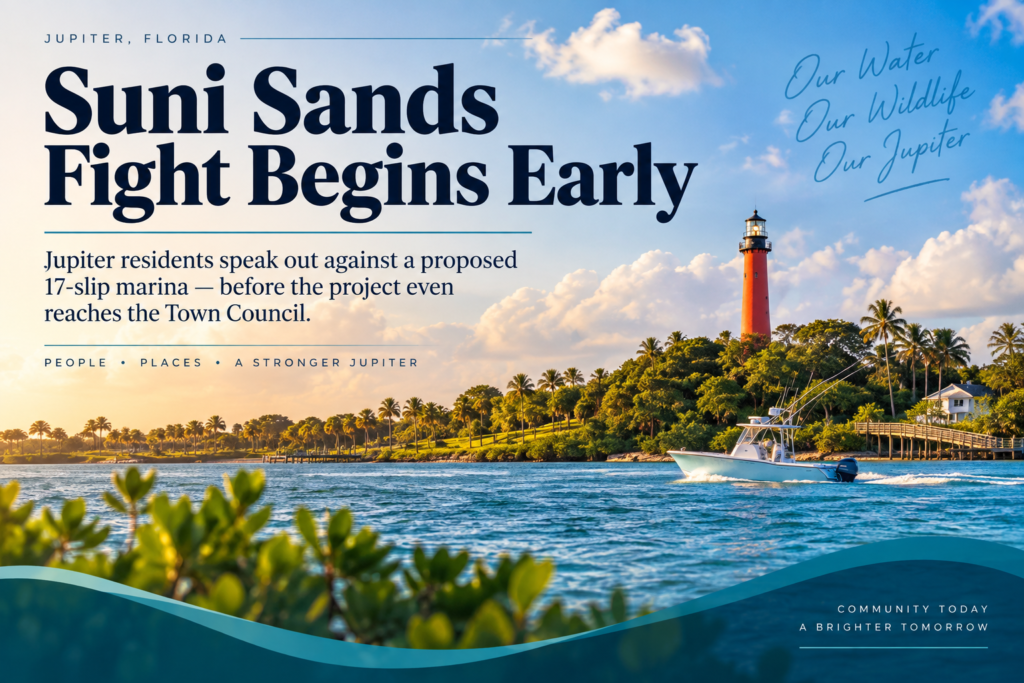
JUPITER — The proposed redevelopment of the Suni Sands property wasn’t on the Town Council’s agenda Tuesday night.
That didn’t stop a dozen people from showing up to oppose it.
All 12 residents and advocates who signed up for public comment at the Sept. 8 special meeting came to speak about Suni Sands, focusing much of their opposition on a proposed 17-slip marina and its potential effects on seagrass and wildlife near the Jupiter Inlet.
Their appearance amounted to an unusually early public campaign over a project the council was not scheduled to consider that evening.
“We’re all sick and tired of being reactive and we’ve chosen to be proactive tonight,” resident Caitlin Wood told council members. She said the speakers knew the project was not on the agenda but wanted to make their objections known before it reached the council for a decision.
The turnout prompted Mayor Jim Kuretski to address Suni Sands before the council even began its budget hearing.
Kuretski said social media posts had promoted the meeting as an opportunity to speak about the project and may have created the impression that it would be considered that night. He emphasized that it was not an agenda item and said any future development hearings would have to go through the town’s required public-notice procedures.
The town’s Sept. 8 public notice identified the meeting as a special Town Council meeting following a Community Redevelopment Agency budget workshop.
But when the meeting reached public comment about 40 minutes later, Suni Sands dominated the room.
A fight centered on the water
Much of the opposition focused not simply on development of the waterfront property, but specifically on the proposed marina.
Vivian McLean Bunce, president of the Jupiter Inlet Foundation, told the council the proposal should not be viewed as merely a request for 17 boat slips.
“It is a request to place a 17-slip marina through a significant and flourishing seagrass habitat in the Suni Sands Estuary,” she said.
Bunce argued that the marina requires a special exception under town rules and said the council ultimately will have to decide whether granting that exception is consistent with Jupiter’s comprehensive plan and environmental policies.
She also pointed to a 2020 decision involving the nearby Pelican Club, saying a request to add a slip to that marina was denied after environmental concerns were raised.
“If four slips were inconsistent with the town’s environmental policies in that location, how can 17 slips through an even larger and more vulnerable seagrass area be consistent with the same policies?” Bunce asked.
Those claims about the applicable town code, the earlier Pelican Club decision and how the two applications compare would need to be independently verified as the Suni Sands application proceeds.
The Jupiter Inlet Foundation also asked the town to consider something more sweeping than denying a marina.
Cheryl Snyder, speaking for the foundation, said the applicant is seeking future land-use changes that would place only part of the shoreline under a conservation designation. The organization wants the entire shoreline designated for conservation instead.
Snyder argued that such a move could provide permanent protection for the seagrass habitat rather than forcing environmental groups to fight individual proposals as they arise.
Turtles, manatees and seagrass
Speaker after speaker returned to the ecological value of the shallow water bordering the property.
Wood told council members that the seagrass site has been monitored for years and supports fish and shellfish habitat while providing food for larger animals. She cited a Loxahatchee River District report that she said identified development, docks, dredging and increased boating traffic among threats to seagrass.
Another resident, Zachary Burr, said he had brought images taken by drone on multiple dates showing green sea turtles and manatees in the Suni Sands area. He offered to provide additional imagery documenting wildlife activity.
Other speakers approached the issue less technically.
Kieran Kidder, who described himself as an avid angler and 25-year Jupiter resident, said he has watched local fishing decline and worries additional marina activity would compound pressures on marine habitat.
“We have so many marinas already,” Kidder said. “We do not need just to see this destruction of this habitat.”
The environmental assertions made during public comment have not been established by the council simply by being presented at the meeting. Determining the marina’s potential impact will require review of the applicant’s plans, environmental studies and the town’s eventual staff analysis.
More than an environmental fight
The comments also revealed that the debate over Suni Sands is likely to become about more than seagrass.
Speakers invoked Jupiter’s history, archaeological resources, boating culture, development pressure and the question of what kind of waterfront community Jupiter wants to become.
One speaker raised claims about Native American artifacts and archaeological resources on the property. The historical importance of Suni Sands has surfaced in town discussions before: during a 2024 planning meeting, officials discussed the historic mound at Suni Sands as a cultural resource that could qualify for future CRA investment.
Longtime resident William Kimball urged officials to think about alternatives to conventional waterfront development.
Instead of only saying no to a proposal, he suggested imagining the site as a community gathering place with a green market, family activities, music and views of the Jupiter Inlet Lighthouse.
“What could we do with it?” Kimball asked. “What could be a legacy?”
Kimball ended his remarks with a question that drew a response from the next speaker as well: “Are you being a good ancestor?”
Others framed the debate around the rapid transformation they say they have watched across Jupiter and South Florida.
Sergey Kelly urged the council to “keep Jupiter, Jupiter,” arguing that the cumulative effect of continued development could eventually change the character that draws people to the town in the first place.
Residents aren’t waiting for the hearing
Perhaps the clearest message Tuesday was that opponents don’t intend to wait until a formal Suni Sands hearing to organize.
That is a notable shift in tone for a development dispute.
Instead of arriving at the meeting where council members are preparing to cast a vote, opponents are trying to shape the conversation before the proposal gets that far.
Kuretski reiterated after public comments that he was pleased attendees understood Suni Sands had not been scheduled for consideration that evening. Council members thanked the speakers and said they were available to hear more from residents.
The mayor said later in the meeting that he had seen social media communications suggesting Suni Sands was on the agenda but was glad those who attended apparently understood otherwise.
The town’s online records system provides public access to council and Planning and Zoning agendas, minutes, ordinances and other records as the proposal moves through the review process.
For the residents who filled the public-comment period Tuesday, however, waiting for the formal process was precisely what they did not want to do.
Their campaign has begun before the council has even been asked for its answer.
